Eating Patterns
The Rhythm Behind a Nutritionist's Weekly Food Record
Eleanor Whitfield··9 min read

Eating with the seasons is less a lifestyle position than an observation about variety. When the available range of vegetables and fruits shifts with the calendar, so too does the nutritional composition of what reaches the plate — quietly, without requiring deliberate planning.
There is an argument — modest but well-supported by published nutritional research — that the human body's relationship with food has always been shaped by seasonal availability. Before the industrial standardisation of food supply, the range of plant foods accessible in winter was genuinely different from those available in summer. This variation was not a disadvantage. It was, in fact, a form of nutritional programming.
Contemporary nutrition has largely decoupled food from season. Tomatoes in January, strawberries in November — availability has become uniform across the calendar year. This is not, on balance, harmful. But the flattening of seasonal variety has a subtle consequence: it reduces the natural rotation of plant-based nutrients across the year, replacing diversity with the repetition of a smaller set of year-round staples.
From a nutritionist's perspective on weight, this matters because different seasonal vegetables and fruits bring different fibre profiles, micronutrient densities, and satiety characteristics. A plate that shifts with the calendar is a plate that rotates its nutritional inputs — and rotation, over time, supports a more balanced and sustainable relationship with food and weight.
Seasonal eating is not a restriction — it is a rotation. The year's calendar becomes a nutritional index, cycling through varieties that no static shopping list can replicate.
In the English context, the seasonal calendar offers a genuinely wide range of plant foods across the twelve months. Spring brings asparagus, spring greens, radishes, and wild garlic. Summer extends into courgettes, broad beans, fresh peas, tomatoes, and berries of several kinds. Autumn is, by any nutritional measure, the richest season: squash, root vegetables, kale, Brussels sprouts, leeks, apples, and pears. Winter, often considered lean, offers swede, celeriac, savoy cabbage, purple sprouting broccoli, and stored roots.
Each of these seasonal windows brings a different fibre profile. The long-chain fibres of winter root vegetables behave differently in the digestive system from the short fibres of summer courgettes. The water content of summer tomatoes differs from the dry density of autumnal squash. These are not marginal differences — they alter how long a meal sustains a sense of fullness, and how the body's energy patterns track through the hours after eating.
For those maintaining a food journal, one of the most instructive exercises is to note the seasonal origin of the vegetables consumed across a week and observe whether the plate reflects the actual calendar or the standardised supermarket offering. The gap between the two is often larger than expected.

Weight, understood as a measure of the body's relationship with food, activity, and energy balance, does not remain static across the year — and nor should it be expected to. Published dietary research consistently shows that weight tends to drift slightly upward in winter months, not as a failure of individual resolve, but as a biological response to reduced activity, reduced daylight, and the higher caloric density of cold-season foods.
What is less often discussed is the role of seasonal produce in moderating this drift. The high fibre content and water density of autumn and winter vegetables — when actually consumed in adequate quantities — provide a natural counterbalance to the heavier, warmer cooking styles that cold months invite. A winter diet anchored in kale, squash, leeks, and roots is not a restricted diet. It is, in fact, a diet of considerable flavour and volume. Its relationship to gradual weight change is characterised less by reduction than by stability.
Spring and summer bring a natural lightening of the plate: more raw preparations, higher-water produce, lighter cooking. This shift, if followed with some attentiveness, corresponds for many people with a gentle and unremarkable return toward a lower weight without deliberate effort. The season does much of the work — if the kitchen allows it.
"There is a quiet elegance to eating with the calendar. The plate rearranges itself, season by season, without requiring a diet to do so."
The concept of plant-based meals has, in recent years, acquired associations with a particular dietary identity. In the nutritionist's perspective, however, plant-based eating is better understood as a structural approach: meals in which vegetables, legumes, whole grains, and fruits make up the majority of the plate, regardless of whether any animal products are present in a supporting role.
When this structural approach is aligned with seasonal availability, the results are interesting from a weight and lifestyle standpoint. The sheer volume available — a plate of roasted root vegetables in winter, or a summer salad of broad beans and fresh tomatoes — tends to produce a sense of satiety that is difficult to achieve with smaller volumes of denser foods. The fibre, the water content, the time required to eat a plant-heavy plate: all of these factors contribute to what food research describes as high satiety per calorie.
For those exploring gradual weight change without specific restriction, a plant-based seasonal approach offers a practical framework. No foods are forbidden. The structure simply prioritises what is available, in season, and most abundant — which, across the year, produces considerable variety without the psychological weight of a formal programme.

The practical challenge of seasonal eating in England is not one of availability — it is one of habit. Most household shopping patterns are fixed: the same vegetables week after week, sourced from the same aisle, without reference to the calendar. To shift this pattern does not require a dramatic restructuring of how food is purchased. It requires, initially, only curiosity.
A useful entry point is to identify one or two vegetables that are at peak seasonal availability in the current month and build a single weekly meal around them. In February, that might be purple sprouting broccoli. In September, it might be a small Crown Prince squash. The goal is not to transform the entire week's eating — it is to establish a connection between the calendar and the kitchen that, over time, becomes self-reinforcing.
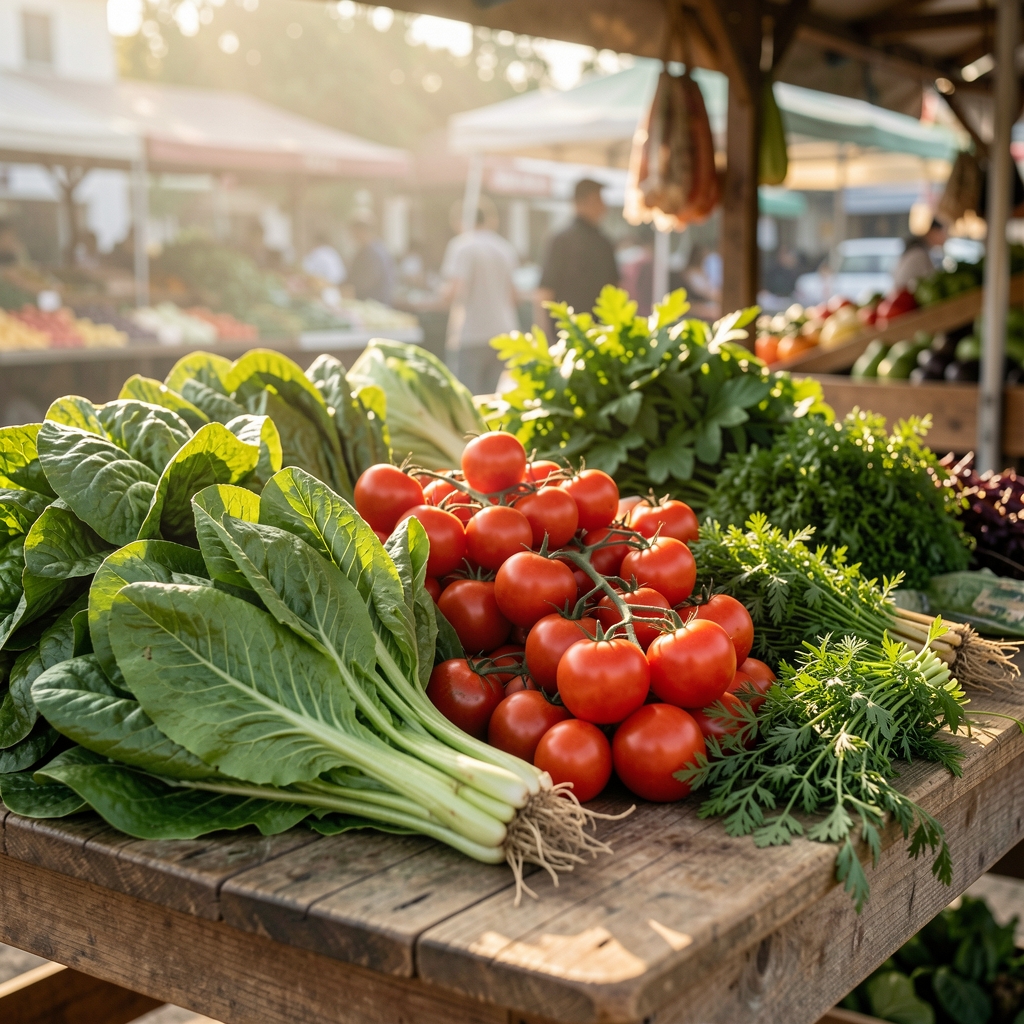
Markets and greengrocers remain more reliably seasonal than supermarkets, though the latter have improved. A seasonal produce chart — several are freely available from UK farming organisations — is a practical reference that requires no special knowledge to use. Over the course of a year, a kitchen guided by such a chart will, without any further directive, have consumed a meaningfully wider range of plant-based nutrients than one that does not consult it.
For the food journal, noting the season of key produce consumed each week adds a dimension that standard nutritional logging ignores. Across twelve months, the resulting record is not just a food diary — it is a nutritional map of the year's eating, with all its shifts, drift, and moments of surprising abundance.

Tobias Marsden writes on seasonal food, agricultural cycles, and their relationship with everyday nutrition. His observations draw on field notes gathered across English markets, kitchens, and growing seasons over the past decade.
More from Talek Letters →